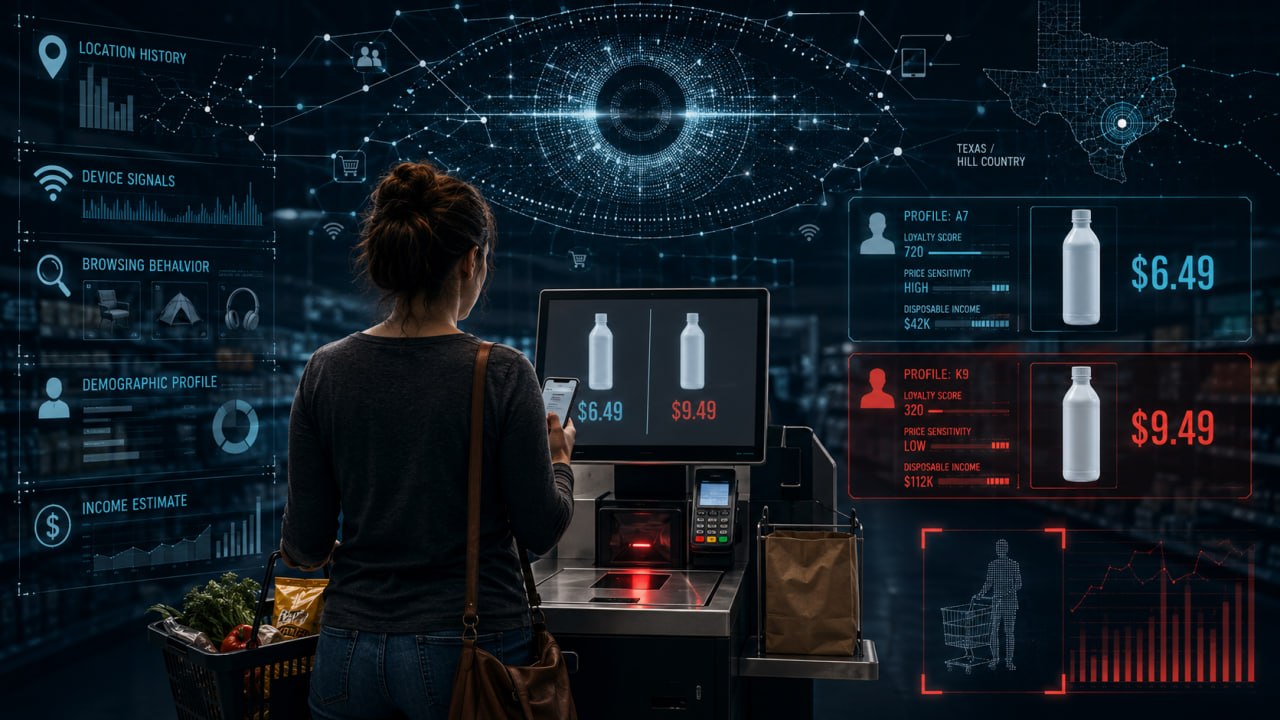
Inside the billion-dollar surveillance pricing industry that knows your salary, tracks your desperation, and bills you accordingly
You and your neighbor open the same app, at the same moment, and order the same ride to the same airport. You pay $52.95. She pays $36.94.
Neither of you did anything different. The algorithm simply decided you were worth more — or, more precisely, that you would tolerate more. Welcome to surveillance pricing: the fastest-growing, least-visible revenue strategy in American commerce, and one that remains, in most of the country, entirely legal.
The End of the Price Tag
For over a century, retail operated on a simple social contract: one product, one price, posted for everyone. That contract is quietly being shredded. In its place, corporations have built an infrastructure that ingests your location, your device, your browsing hesitations, your battery level, and your purchase history — and uses it all to answer a single question: What is the absolute maximum this specific person will pay, right now, before walking away?
Economists have a name for the endgame: first-degree price discrimination — the theoretical scenario in which a seller knows so much about every buyer that it can charge each of them their personal breaking point. In that world, “consumer surplus” — the economic term for the value you keep when you pay less than you were willing to — is mathematically eliminated. Every dollar of it flows to the seller.
That used to be a textbook abstraction. Now it’s a product category. Investigations into the industry have found that vendors of algorithmic pricing software boast to retail clients that their systems can reliably lift total revenue 2 to 5 percent — not by selling more goods, but purely by extracting more from the same customers. Controlled testing has found certain consumers paying up to 23 percent more for identical grocery items, an invisible tax that can cost a household an estimated $1,200 a year.
The Machine Behind the Curtain
Surveillance pricing doesn’t run on one creepy tracker. It runs on a supply chain.
At the top sit data brokers like Acxiom and Epsilon, compiling dossiers on nearly every American consumer — industry insiders report that major grocery chains maintain profiles averaging 63 pages per shopper. Below them sit the identity-resolution layers: mobile advertising IDs, device fingerprints, and cross-device graphs that stitch your phone, laptop, and smart TV into a single household profile. Clearing your cookies or going “incognito” is theater; the graph already knows who you are.
Then comes the behavioral layer, and this is where it gets unsettling. Pricing engines don’t just track what you buy. They track how you move — scroll depth, mouse hesitation, how long you linger before clicking, whether you’ve abandoned carts before. These micro-signals are treated as a live readout of your urgency and price sensitivity. Your hardware talks, too: travel sites were caught years ago steering Mac users toward pricier hotels on the theory that Apple ownership signals a fatter wallet.
And location may be the most powerful input of all. Algorithms compute what can only be described as geographic desperation. Consumers shopping for office supplies from zip codes with no nearby hardware store have been charged more — because the system correctly inferred they had nowhere else to go.
This is not “dynamic pricing,” despite what corporate lobbyists want regulators to believe. Surge pricing during a rainstorm hits everyone equally; it’s a market-clearing mechanism. Surveillance pricing is something categorically different: it’s the app noticing you specifically are late for a flight, and raising the price for you alone.
Field Evidence: The Drone Over the Rich Neighborhood
Some of the most damning evidence comes from real-world field experiments, including a remarkable investigation by YouTube creator Chris the Producer in his documentary “I beat BIG TECH’s new predatory pricing tactics (and saved $6,593),” which put the algorithms to the test in ways that reveal how deeply this system discriminates.
Chris wanted to test how algorithms price the residents of North Oaks, Minnesota — a gated, private municipality that is the state’s wealthiest zip code, and the only municipality in America not on Google Street View. Since he couldn’t physically enter (he had been legally banned from the property after a previous video), he attached a smartphone to a drone, flew it into the unrestricted airspace above North Oaks, and initiated transactions remotely.
The results inverted every assumption about who pays more. A rideshare requested from inside the wealthy enclave: $54.95. The identical ride requested from a device just outside the border: $75.96 — a 28 percent premium for being on the wrong side of the fence. A White Castle delivery order ran $39.47 inside North Oaks and $47.25 outside it.
The affluent, it turns out, get discounts. The algorithm reasons that rich consumers have cars, options, and low urgency — they must be wooed with competitive prices. The captive customer in a transit desert, relying on a delivery app because there’s no alternative? That’s who gets the desperation premium. Willingness to pay, the industry has learned, doesn’t track income. It tracks lack of alternatives — and the people with the fewest alternatives are, by definition, the people who can least afford the markup.
The pattern repeats across sectors. A can of Spam at Target: $4.99 for one profile, $4.59 for another. The same Denver hotel room, same night: anywhere from $122 down to $84 depending on who’s asking. Investigators who masked a high-income Bay Area IP address watched hotel prices drop by $200 to $500 a night.
You Cannot Opt Out by Being Clever
Perhaps the bleakest finding from Chris the Producer’s investigation: you can’t outrun this by going off-grid.
In an elaborate evasion test documented in the video, Chris formed an anonymous Wyoming LLC through a local proxy, obtained credit instruments fully decoupled from his identity, bought a prepaid burner phone activated in a low-income zip code, and spent days manually training the device to look like a broke, low-intent shopper — walking through college neighborhoods, searching for free stuff, never completing a purchase. He even hired an improv actor to play the role of “Frank Reynolds, LLC,” sending him out into the world to build a digital footprint of someone who would never pay full price for anything.
Then he priced identical baby products on both devices. The pristine burner identity was quoted $34.99. His real, heavily surveilled personal phone: $28.99. The elaborate disguise earned him a 20 percent penalty.
Why? Because the algorithms don’t score data points — they score plausibility. A device with no cookie history, unnatural browsing patterns, or a Wi-Fi association with a known profile gets flagged as anomalous, and anomalies get priced defensively. The black box cannot be consistently outsmarted with analog tricks. The house always knows.
As Grace Getty from Consumer Reports noted in the video, “Companies don’t tend to pursue new pricing tactics unless they think it’ll increase their profits.” David Dean, who actually coined the phrase “surveillance pricing,” confirmed the opacity is intentional: the companies “100%” don’t want you to know how it works, “because that’s the only way they can get away with it.”
The “Discount” Is the Con
Corporations understand that “we charged you more because we profiled you” is a public-relations catastrophe. So the extraction wears a friendly mask: personalized discounts.
The mechanism is baseline manipulation. Inflate the “regular” price for everyone, then selectively hand out “discounts” calibrated to each shopper’s profile. The loyal customer who will never switch brands? The algorithm quietly excludes her from every promotion — she pays full inflated freight, forever, as a loyalty tax. The wavering customer flagged as a churn risk gets the coupon. Investigations into platforms like Instacart even found different users being shown different original prices before the “discount” was applied — anchoring manipulation, engineered per person.
The math is identical to surveillance pricing. The optics are a rewards program. And critically, this trick sails through most of the new state laws being written to stop the practice.
Regulators Are Circling — Slowly
In July 2024, the FTC invoked its rarely used Section 6(b) authority to pry open the industry, subpoenaing not the retailers but the pricing middlemen: Mastercard, JPMorgan Chase, Revionics, PROS Holdings, Bloomreach, Task Software, Accenture, and McKinsey. The Commission’s preliminary findings, released in January 2025, confirmed the core allegation — intermediaries were using granular data including precise geolocation, browser history, and device telemetry to sort individuals into behavioral segments and hit them with automated, targeted prices.
Antitrust enforcers have opened a second front: the “hub-and-spoke” theory. When dozens of competing retailers all feed proprietary sales data into the same third-party pricing algorithm, that algorithm effectively coordinates prices across the industry — collusion with no smoke-filled room required, just a shared SaaS subscription. Congressional scrutiny of Instacart has centered on exactly this dynamic.
Meanwhile, the states are producing a patchwork — over 89 bills across 27 states. New York now mandates an on-screen warning: “THIS PRICE WAS SET BY AN ALGORITHM USING YOUR PERSONAL DATA.” Maryland passed the nation’s first outright ban — but only for large grocers, and with a gaping exemption for loyalty programs, the very trojan horse through which grocers harvest the data in the first place. And virtually none of the new laws touch baseline manipulation. Raise the sticker price for everyone, discount selectively, and you’ve laundered surveillance pricing into legality.
What Texans Actually Have
For consumers in Texas — including here in the Hill Country — two statutes matter.
The Texas Data Privacy and Security Act (effective July 2024) attacks the data supply chain. It classifies precise geolocation as sensitive data requiring genuine opt-in consent, covers “pseudonymous” device IDs whenever they’re linkable to a person (neutralizing the “it’s just an anonymous ID” defense), and — as of January 2025 — legally obligates covered businesses to honor Global Privacy Control signals broadcast by your browser. Flip that one browser setting, and companies must stop selling your data to the brokers feeding the pricing engines. Enforcement runs through the Attorney General at up to $7,500 per violation — an existential number for a system processing thousands of profiled transactions a minute. The catch: there’s no private right of action, and companies get a permanent 30-day cure period.
The Deceptive Trade Practices Act attacks the outcomes. Fake “regular” prices inflated to manufacture personalized discounts are textbook deceptive pricing under Texas law. And when the next hurricane or grid failure triggers a disaster declaration, any algorithm that automatically surges the price of water, fuel, lodging, or building materials is committing price gouging — up to $10,000 per violation, $250,000 when victims are over 65. Unlike the privacy law, the DTPA lets consumers sue directly, with treble damages on the table for intentional deception.
The Bottom Line
Surveillance pricing is not a glitch in the digital economy. It is the digital economy’s business model reaching its logical conclusion: if data can predict what you’ll tolerate, data will be used to charge it. Polling shows 76 percent of consumers want the practice banned outright. Instead, what they’ve gotten is a compliance patchwork riddled with loyalty-program loopholes, a federal investigation still grinding through subpoenaed documents, and an industry that has already learned to disguise the markup as a coupon.
Until the law catches up, the uncomfortable truth is this: the price tag is dead, and what replaced it is a mirror. Every price you see is a calculation of who the algorithm believes you are — and how badly it believes you need what’s in your cart.
Field experiment findings in this article are sourced from Chris the Producer’s documentary “I beat BIG TECH’s new predatory pricing tactics (and saved $6,593)” on YouTube. Additional research compiled from FTC investigation records, state legislative analysis, controlled pricing experiments, and economic literature on algorithmic price discrimination.